

Board Performance · 2025
In this section14 topics
- Compliance Monitoring — Overview1 item
- Prevention of Conflicts of Interest3 items
- Prevention of the Use of Inside Information3 items
- Anti-Corruption4 items
- Whistleblowing3 items
- Selection of Directors & Chief Executives6 items
- Selection of Independent Directors2 items
- Evaluation of Board & Subcommittee Performance3 items
- Subcommittees1 item
- Meeting Attendance & Remuneration4 items
- Supervision of Subsidiaries & Associated Companies4 items
- Board Duty Performance — Overview1 item
- Audit Committee Duty Performance1 item
- Executive Committee Duty Performance1 item
Compliance Monitoring — Overview
Monitoring of Compliance with Other CG Policies & Guidelines
Compliance with other good corporate governance principles
1. The Company was assessed under the CGR 2025 project to survey and monitor the corporate governance development of listed companies. In 2025, the Company achieved a 'Good' level by the Thai Institute of Directors (IOD).
2. The Company was assessed by the 'Annual General Meeting Quality Assessment (AGM Checklist) 2024' project by the Thai Investors Association, receiving an assessment score of 97.5/100.
Prevention of Conflicts of Interest
Has the Company Acted to Prevent Conflicts of Interest?
Yes
Operations in the Past Year
Prevention of Conflicts of Interest
To prevent conflicts of interest and ensure transparent and auditable operations, the Company has a clear policy on the disclosure of connected transactions, inter-company transactions, and conflicts of interest to build confidence among shareholders, investors, and stakeholders. Significant connected transactions or inter-company transactions must be considered and approved by the Audit Committee and the Board of Directors. The Company will adhere to the criteria, conditions, and procedures stipulated in the Notification of the Stock Exchange of Thailand Board regarding the Disclosure of Information and Practices of Listed Companies concerning Connected Transactions. The Company has disclosed connected transactions under Section 9.2 Inter-Company Transactions.
In 2025, the Company found no violations of the policy on disclosure of connected transactions, inter-company transactions, and conflicts of interest. All transactions were duly and completely considered and approved by the Audit Committee and the Board of Directors. Furthermore, the Board of Directors was informed of the disclosure reports on securities trading and changes in securities holdings by the company's directors, executives, company auditors, and individuals related to the aforementioned persons. Whistleblowing reports, complaints, and reports on connected transactions, inter-company transactions, prevention of conflicts of interest, and reporting of interests are submitted quarterly. The Company has appointed the Company Secretary to receive notifications regarding directors' interests, for onward reporting to the Chairman of the Board and the Chairman of the Audit Committee.
The Company has communicated its policies to directors, executives, and employees via the company's intranet system to foster awareness and understanding for proper implementation. In 2025, there were directors Number 8 directors, 25 executives, and 336 employees (company support staff) have been fully briefed on the said policy, representing 100% of the company's total personnel.
Further details regarding the "Policy on Connected Transactions, Inter-Company Transactions, Prevention of Conflicts of Interest, and Reporting of Interests" can be found on the company's website https://www.stpi.co.th/investor-relations-th/corporate-governance/
Number of Conflict-of-Interest Cases
| Metric | Current Year | Previous Year | Two Years Ago |
|---|---|---|---|
| Total number of cases or issues related to conflicts of interest (cases) | 0 | 0 | 0 |
Prevention of the Use of Inside Information
Has the Company Acted to Prevent the Use of Inside Information?
Yes
Operations in the Past Year
Oversight of Insider Information Usage
Directors, executives, and employees must comply with the "Policy on Insider Information Usage and Securities Trading," which sets out criteria and guidelines for securities trading by directors, executives, and designated persons of the company. They are required to report their securities holdings to the Securities and Exchange Commission (SEC) under Section 59 of the Securities and Exchange Act B.E. 2535 within 3 days from the date of change in securities holdings, by submitting the form electronically to the SEC, and to inform the Company Secretary for the purpose of recording changes and summarizing individual securities holdings of directors and executives.
In practice, the company has informed those involved with financial information about prohibiting the disclosure of financial statements or other information affecting the company's securities prices, which they are aware of, to external parties or those not involved, during the period before the financial statements or other information affecting the company's/group's securities prices are released to the public. Non-compliance with these regulations is considered a disciplinary offense by the company. If any director, executive, or employee who has prior knowledge of significant inside information commits a disciplinary offense, they will be subject to penalties ranging from a warning, salary reduction, suspension without pay, to termination of employment. This must be in accordance with the rules and guidelines of the Stock Exchange of Thailand. Various communications have been made, emphasizing the establishment of a Blackout Period policy, which prohibits trading of securities during the 1-month period before the financial statements or other information affecting the company's/group's securities prices are released to the public, and prohibits trading of the company's securities until 24 hours have passed. Compliance with this policy has been communicated to all relevant directors and executives through meetings and the company's internal Intranet system.
In 2025, the Company Secretary notified the relevant directors, executives, and employees of the Blackout Period via e-mail, and no trading of the company's securities by directors, executives, or relevant employees was found during the company's Blackout Period.
In 2025, the company found no violations of the "Policy on Insider Information Usage and Securities Trading" and reported changes in securities holdings, as detailed in the securities holding reports of the company's directors, executive directors, and executives.
The company has communicated its policies to directors, executives, and employees through the company's intranet system to raise awareness and understanding for appropriate implementation. In 2025, there were directors totaling 8 persons, 25 executives, and 336 employees (employees in the company's support functions). have been fully informed of the said policy, representing 100% of the company's total personnel.
Number of Inside-Information Cases
| Metric | Current Year | Previous Year | Two Years Ago |
|---|---|---|---|
| Total number of cases or issues related to the use of inside information to seek benefits (cases) | 0 | 0 | 0 |
Anti-Corruption
Has the Company Acted on Anti-Corruption?
Yes
Operations in the Past Year
Anti-corruption
The Company recognizes the importance of anti-corruption. It has established a written Anti-Corruption Policy and actively clarifies and supports directors, executives, and employees in understanding and recognizing this importance. A written policy on receiving/giving gifts, gratuities, or other benefits has been established, along with guidelines for reporting suspicions of fraud, corruption, and giving or receiving bribes. There are complaint and whistleblowing processes, and measures to protect whistleblowers and complainants, which are part of the Anti-Corruption Policy. The Anti-Corruption Policy and the policy on receiving/giving gifts, gratuities, or other benefits will be reviewed at least once a year. The Audit Committee will approve and propose it to the Board of Directors for consideration and approval at the Board of Directors Meeting No. 6/2568 on December 12, 2568.
Corruption Risk Assessment: The Internal Audit Department conducted an assessment of risks related to fraud, corruption, and giving or receiving bribes. This involved evaluating, analyzing, monitoring, and controlling corruption risks to an acceptable level, and reporting to the Audit Committee, including monitoring the implementation of the Anti-Corruption Policy and the policy on giving or receiving bribes.
Receiving/Giving Gifts, Gratuities, or Other Benefits: The Company sent an email requesting cooperation to refrain from giving and receiving New Year gifts to customers/partners/government agencies/financial institutions/stakeholders during the New Year festive season. However, the policy clearly defines procedures for receiving/giving gifts, gratuities, or other benefits. The Company Secretary is responsible for monitoring and compiling reports on all gifts, gratuities, or other benefits received during the company's festive seasons and has fully presented them to the Audit Committee, which found that the company's prescribed measures have been implemented.
In 2568, all directors, executives, and employees received a review of their knowledge and understanding of business ethics through communication, encouraging them to study and acquire knowledge about all important company policies via the company's Intranet, from December 17, 2568, until March 20, 2569. This was to ensure a detailed understanding of each policy and its correct application in operations. This included 8 members of the Board of Directors, 25 executives, and and 336 employees (employees in the company's support functions) received clarification and knowledge through studying information on the company's Intranet and new employee orientation, representing 100% and possessing knowledge and understanding at the level prescribed by the company.
In 2568, the Company conducted an anti-corruption review and found no cases of internal corruption.
Form of Anti-Corruption Operations
| Operation |
|---|
| Communication and training for employees on anti-corruption policy and guidelines |
| Review of appropriateness in anti-corruption |
Number of Corruption Cases
| Metric | Current Year | Previous Year | Two Years Ago |
|---|---|---|---|
| Total number of cases or issues related to corruption (cases) | 0 | 0 | 0 |
Whistleblowing
Has the Company Implemented Whistleblowing Procedures?
Yes
Operations in the Past Year
The company has a whistleblowing policy and measures to protect whistleblowers, granting all employees and stakeholders the right to report corruption or bribery, and violations of laws or ethics. Channels are provided for reporting and complaints to the Chairman of the Audit Committee, independent directors, and in 2025, the company did not receive any whistleblowing reports or complaints through these channels.
In 2025, all directors, executives, and employees received a review of their knowledge and understanding of business ethics through a communication method that required all directors, executives, and employees to study and acquire knowledge about all important company policies via the company's Intranet, starting from December 17, 2025, until March 20, 2026, to ensure a detailed understanding of each policy and its correct application in operations. This included 8 company directors, 25 executives, and and 336 employees (employees in the company's support division). received clarification and knowledge through studying information on the company's Intranet and new employee orientation. This represents 100% and demonstrates a level of knowledge and understanding as determined by the company.
Number of Whistleblowing Cases
| Metric | Current Year | Previous Year | Two Years Ago |
|---|---|---|---|
| Total number of cases or issues received through whistleblowing channels (cases) | 0 | 0 | 0 |
Selection of Directors & Chief Executives
Selection — Introduction
The Company provided an opportunity for its shareholders to propose agenda items for the Annual General Meeting of Shareholders and to nominate qualified individuals for election as company directors in advance for the Annual General Meeting of Shareholders in 2025, in accordance with the Company's criteria regarding shareholders' right to propose agenda items for the Annual General Meeting of Shareholders in advance and to nominate qualified individuals for election as company directors. The Company published an announcement on its website at www.stpi.co.th on December 11, 2024, informing minority shareholders to nominate suitable candidates for company director to the Company by January 10, 2025. It appeared that upon the deadline, no shareholder nominated any individual for company director.
In considering the reappointment of existing directors for another term, the Nomination and Remuneration Committee will consider various factors, including performance, attendance records, participation in meetings, and support for the Board of Directors' activities. For independent directors, their independence will also be considered.
Newly appointed directors will receive an orientation to understand general information, an overview of key business operations, and a summary of the Company's performance. They will also be informed about compliance with relevant laws and regulations, such as the roles and responsibilities of directors in a listed company, the policy on insider information and securities trading, and other related policies. The Company Secretary will present and prepare relevant company information for the new directors.
Are Directors Selected Through the Nomination Committee?
Yes
Are Chief Executives Selected Through the Nomination Committee?
Yes
Number of Directors from Major Shareholders
0
Rights of Minority Shareholders on Director Appointment
Each shareholder shall have votes equal to the number of shares held, meaning one share equals one vote.
-
Each shareholder shall cast all votes they possess to elect one or more individuals as directors. In the case of electing multiple individuals as directors, votes cannot be divided among candidates in varying proportions. During voting, shareholders shall use a ballot to appoint directors individually, according to the list of individuals nominated as directors on the ballot.
-
Individuals who receive the highest number of votes in descending order shall be elected as directors, equal to the number of directors to be appointed or elected at that time. In the event that individuals elected in the subsequent order receive an equal number of votes exceeding the number of directors to be appointed or elected at that time, the chairman shall cast the deciding vote.
Method of Director Appointment
| Method |
|---|
| Method whereby each director requires approval votes more than half of the votes of attending shareholders with voting rights |
Selection of Independent Directors
Criteria for Selecting Independent Directors
The selection process for the company's directors has undergone careful screening and consideration by the Nomination and Remuneration Committee. This includes evaluating the qualifications of the company's directors in accordance with the Public Limited Company Act B.E. 2535 (and its amendments), educational qualifications, skills, work experience in businesses related to the company's operations, and professional diversity that can benefit the business and help develop the company, as well as their past performance as company directors.
The Nomination and Remuneration Committee considers the suitability components, which include the qualifications of both current and future directors, diversity in terms of gender, age, and experience, legal offense history, independence, business direction, and the overall composition of the Board of Directors, to compare with the current and future business directions. A Board Skill Matrix table is prepared to establish criteria for the annual recruitment of desired directors. In this review, the Nomination and Remuneration Committee also considers diversity in the sources of nominations, such as recommendations from company directors, nominations by shareholders, and the director database of the Thai Institute of Directors Association, among others.
For independent directors, the Nomination and Remuneration Committee has considered the qualifications of independent directors according to the definition of independent directors set by the Capital Market Supervisory Board, the Stock Exchange of Thailand, as well as significant business relationships between the company and directors that may affect their ability to perform their duties independently when nominating individuals to be company directors.
The company's independent directors possess characteristics that comply with the criteria of the Securities and Exchange Commission, as follows:
1. Holds shares not exceeding 1% of the paid-up registered capital of the company, its subsidiaries, associated companies, or related companies, including shares held by related persons, namely spouse, minor children, or nominee.
2. Is a director who does not participate in the management of the company, its subsidiaries, associated companies, related companies, or major shareholders of the company, and is not an employee, staff member, or consultant receiving a regular salary from the company, its subsidiaries, associated companies, related companies, or major shareholders of the company.
3. Is a director who has no direct or indirect benefits or interests, both financial and managerial, in the company, its subsidiaries, associated companies, or major shareholders of the company, and also has no such benefits or interests within 1 year prior to appointment, unless the Board of Directors has carefully considered and determined that such past benefits or interests will not affect the performance of duties and the provision of independent opinions.
4. Is a director who is not a related person or close relative of the executives or major shareholders.
5. Is a director who has not been appointed to represent the interests of the company's directors, major shareholders, or shareholders who are related to the company's major shareholders.
Currently, the company has a total of 4 independent directors, or 50% of the total number of directors, namely Dr. Vicha Jiwalai, Police General Jet Mongkolhatthi, Ms. Sirangrong Choviwattana, and Mr. Kanit Walyapetch. They are able to perform their duties, express opinions, or report on their performance as assigned by the company's Board of Directors independently, without being under the influence of the company's directors, executives, officers, or major shareholders, including related persons or close relatives of the aforementioned individuals, whether due to familiarity, deference, or any other reason that might compel them not to express their opinions as they should, and they have no business relationships or professional service relationships with the company.
In addition to the aforementioned qualifications, the company has criteria for selecting independent directors, which stipulate that there must be at least one independent director with knowledge, understanding, and experience in accounting and finance to also serve as an audit committee member, out of a total of 3 audit committee members.
Furthermore, the said committee has carefully considered the remuneration by taking into account (a) a comparison with the business nature and size of other public limited companies listed on the Stock Exchange of Thailand, to ensure appropriateness in accordance with the principles of good corporate governance of the Stock Exchange of Thailand, and (b) the trend of the company's workload, whether increasing or decreasing. In 2025, the company held a total of 2 meetings of the Nomination and Remuneration Committee to propose matters to the Board of Directors for further consideration and acknowledgment. A report of the Nomination and Remuneration Committee was also prepared and disclosed in the company's Form 56-1 One Report. Details of the 2025 Nomination and Remuneration Committee report are provided under item 8.3 Remuneration.
Did Any Independent Director Have a Business or Professional Relationship?
No
Evaluation of Board & Subcommittee Performance
Criteria for Evaluating Board Performance
The performance evaluation of the Board of Directors is conducted both as a whole board and individually (self-assessment) once a year, with details as follows:
• Performance Evaluation of the Board of Directors as a Whole
The performance evaluation of the Board of Directors as a whole is divided into 6 items, following the guidelines of the Stock Exchange of Thailand, namely:
1. Structure and Qualifications of the Board of Directors
2. Roles, Duties, and Responsibilities of the Board of Directors
3. Board Meetings
4. Duties of Directors
5. Relationship with Management
6. Director Self-Development and Executive Development
The evaluation process is as follows:
1. Conduct a performance evaluation of the Board of Directors as a whole at least once a year.
2. The Company Secretary summarizes and presents the results of the Board of Directors' performance evaluation to the Nomination and Remuneration Committee for consideration of the evaluation results and guidelines for improving the Board's operational efficiency.
3. The Nomination and Remuneration Committee presents the results and guidelines for improving operational efficiency to the Board of Directors.
• Individual performance evaluation of the Board of Directors (self-assessment)
The individual performance evaluation of directors (self-assessment) is divided into 3 main topics, following the guidelines of the Stock Exchange of Thailand, namely:
1. Structure and Qualifications of the Board of Directors
2. Board Meetings
3. Roles, Duties, and Responsibilities of the Board of Directors
The evaluation process is as follows:
1. Directors individually evaluate themselves at least once a year.
2. The Company Secretary summarizes and presents the results of individual director performance evaluations to the Nomination and Remuneration Committee for consideration of the evaluation results and guidelines for improving operational efficiency.
3. The Nomination and Remuneration Committee presents the evaluation results and improvement guidelines for operational efficiency to the Board of Directors.
Evaluation of Board Performance in the Past Year
The evaluation results are based on the following criteria:
0 = Strongly disagree, or no implementation in that matter.
1 = Disagree, or minor implementation in that matter.
2 = Agree, or moderate implementation in that matter.
3 = Agree to a considerable extent, or good implementation in that matter.
4 = Strongly agree, or excellent implementation in that matter.
The overall performance evaluation result of the Board of Directors achieved an average score of level 4, Excellent. Similarly, the individual performance evaluation result of the directors (self-assessment) also achieved an average score of level 4, Excellent. It was observed that the company's directors possess comprehensive knowledge, capabilities, and expertise in various areas, covering all aspects relevant to the company's business operations. This ensures their sufficiency and suitability to effectively perform the duties of the Board of Directors, as evidenced by their oversight in ensuring that management's operations align with the company's strategies, goals, and policies.
Evaluation Results
| Evaluated Body | Group — Carried Out? | Group — Grade / Average Score | Group — Grade / Full Score | Individual (Self-Assessment) — Carried Out? | Individual (Self-Assessment) — Grade / Average Score | Individual (Self-Assessment) — Grade / Full Score | Cross (Assessing Other Directors) — Carried Out? |
|---|---|---|---|---|---|---|---|
| Board Of Director | Y | 4 | 4 | Y | 4 | 4 | N |
| Audit Committee | Y | 4 | 4 | Y | 4 | 4 | N |
| Other Subcommittee | Y | 4 | 4 | Y | 4 | 4 | N |
| Other Subcommittee | Y | 4 | 4 | Y | 4 | 4 | N |
Subcommittees
Subcommittees
| Results of the Subcommittee's Duty Performance |
|---|
A summary of the key duties performed by the Risk Management Committee is as follows:
|
In 2025, the Nomination and Remuneration Committee fully and efficiently performed its duties as stipulated in the Nomination and Remuneration Committee Charter and as assigned by the Board of Directors. Two meetings were held, summarized as follows: 1. Nomination Policy, Criteria, and Methods The Nomination and Remuneration Committee has reviewed the policy, criteria, and methods for the nomination of company directors and sub-committee members, and for the consideration of remuneration, for adherence. The policy covers the appointment and composition, qualifications and prohibited characteristics of directors, term of office, duties and responsibilities, criteria for nominating company directors and sub-committee members, criteria for remuneration consideration, meetings, and reporting. The nomination and remuneration policy, criteria, and methods are accurate, complete, and have been approved by the Board of Directors. Furthermore, the Nomination and Remuneration Committee also considered the Board structure according to the Board Skills Matrix, which is reviewed annually. 2. Nomination and Proposal of Individuals for Directorships The Nomination and Remuneration Committee has searched, selected, and proposed suitable individuals for directorships to the Board of Directors for approval, to be presented to the Annual General Meeting of Shareholders for appointment as company directors. Consideration was given to individuals nominated by minority shareholders and by the Nomination and Remuneration Committee (if any). The consideration took into account qualifications, knowledge, abilities, and experience that are appropriate and consistent with the company's business strategies. In cases where a director is due to retire by rotation and is proposed for re-appointment for another term, their performance during their tenure as a company director, including their contributions to the company, as well as other surrounding factors as stipulated in the nomination policy, criteria, and methods, will be considered. The committee has overseen that the nomination process for company directors and sub-committee members is transparent. The company published an announcement on its website on December 12, 2025, to grant minority shareholders the right to nominate individuals for directorships. Upon the deadline of January 12, 2026, no minority shareholder nominated any individual for a directorship. 3. Remuneration Consideration The Nomination and Remuneration Committee considered and determined the remuneration for the Board of Directors and sub-committees, including meeting allowances and annual bonuses, by benchmarking against other companies in the same industry and of similar size. This was proposed to the Board of Directors for approval before being presented to the Annual General Meeting of Shareholders for final approval. It was resolved to propose to the Board of Directors to consider setting the remuneration for directors, audit committee members, and sub-committee members for the year 2026, which is determined as meeting allowances and annual bonuses for the Board of Directors (excluding other remuneration), totaling not exceeding 10,000,000 Baht (ten million Baht only). This rate is equivalent to the remuneration in 2025. The Nomination and Remuneration Committee has carefully screened this based on the duties and responsibilities of the Board and the work of the directors, types of remuneration, and benchmarking against other companies in the same industry and of similar size. In 2025, the company paid remuneration to directors and sub-committee members in accordance with the rates and within the approved budget from the shareholders' meeting, accurately, reasonably, and completely. 4. Consideration of Guidelines, Criteria, and Processes for Performance Evaluation of the Board and Sub-Committees The Nomination and Remuneration Committee considered proposing to the Board of Directors that the Board and its sub-committees continuously conduct self-assessments of their performance annually, and collectively review their performance, as well as improve and rectify the duties and responsibilities of the Board to benefit the company with maximum efficiency and effectiveness. In 2025, the performance evaluation forms for the Board of Directors and all sub-committees, both collective and individual, were reviewed to ensure they are up-to-date and presented to the Board of Directors for consideration of these self-assessment forms, to be used for self-assessment by the Board and all sub-committees. 5. Performance Evaluation of the Nomination and Remuneration Committee both collective and individual for the year 2025, with the overall evaluation result being at an “Excellent” level. The evaluation results were reported to the Board of Directors to enhance operational efficiency and were disclosed in the annual report. 6. The entire Nomination and Remuneration Committee attended the 2025 Annual General Meeting of Shareholders. on April 28, 2025, to provide explanations and answer questions regarding the nomination and remuneration of the Board and sub-committees to all shareholders equally. |
Meeting Attendance & Remuneration
Meeting Attendance & Remuneration — Introduction
The Board of Directors has participated in approving the formulation of policies and business plans and monitors operational results quarterly. Furthermore, it emphasizes internal control and internal audit systems for the benefit of the Company and its shareholders as a whole. The Company has clearly delineated the roles and responsibilities of the Board of Directors, Audit Committee, Risk Management Committee, Nomination and Remuneration Committee, and Executive Committee towards shareholders to ensure independence in decision-making, as detailed under the "Management Structure" section.
In 2025, the Board of Directors scheduled meeting dates in advance for the entire year and held additional meetings beyond those initially planned. The Company convened a total of 6 Board of Directors meetings. For 2026, the Company has also scheduled meeting dates in advance for the entire year and will inform each director accordingly. A minimum quorum for voting at meetings requires at least two-thirds of the total number of directors to be present. Financial responsibility reports are prepared and disclosed in the Company's Form 56-1 One Report.
The Board of Directors meetings emphasized the importance of monitoring and approving quarterly operating results, which must first be reviewed by the Audit Committee and reported by the Audit Committee for the Executive Committee to consider and implement for the Company's maximum benefit. This also includes reporting significant operational risks of the Company, such as the progress of lawsuits or emerging work issues that could potentially lead to the Company incurring operating losses.
For every Board of Directors meeting, the Company Secretary is responsible for preparing the agenda items and distributing meeting documents to the Board of Directors at least 7 days prior to the meeting. This also includes recording the meeting minutes, noting suggestions and opinions from each sub-committee, namely the Board of Directors, Audit Committee, Nomination and Remuneration Committee, Risk Management Committee, and Executive Committee. Overall, the Company records meeting reports and distributes them to individual directors as appropriate. Approved meeting reports from the Board of Directors are systematically stored and made available for inspection by the Company's Board of Directors and relevant parties.
Meetings of Non-Executive Directors of the Company
The Company mandates meetings among non-executive directors without the presence of management to discuss management's operations and exchange views on various situations that may affect the Company. The guidelines for non-executive director meetings are as follows:
-
Attendees are non-executive directors who do not hold direct or indirect shares exceeding 5%.
-
The procedures for scheduling meetings, notifying directors in advance, and counting the quorum shall follow the same principles as Board of Directors meetings. However, an advance agenda is not strictly required, as these meetings are open to all opinions, provided they are deemed beneficial to the Company.
-
To be held at least once a year, or at an appropriate time determined by the Chairman of the meeting.
In 2025, the Company held one meeting of non-executive directors, comprising a total of 5 individuals, on December 12, 2025. Discussions covered management's operations and an exchange of views on various situations, reviewing the Company's performance for 2025, as well as providing recommendations for management to implement in alignment with the Company's recognized and prioritized vision and strategies. The issues discussed and the meeting outcomes have been communicated to the Managing Director.
Justification for Directors' Non-Attendance
Mr. Chavarat Charnvirakul, Chairman, was unable to attend the 30th Annual General Meeting of Shareholders for the year 2025 due to health issues.
Types of Remuneration of the Board of Directors
The Company has clearly and transparently established its director remuneration policy. The Nomination and Remuneration Committee considers the appropriateness and alignment with the scope of duties and responsibilities of the Company's directors, benchmarks against director remuneration rates in the same industry, and also considers the Company's business expansion and profit growth.
At the 30th Annual General Meeting of Shareholders for the year 2568, the meeting resolved to approve the remuneration for the Company's directors, Audit Committee members, Nomination and Remuneration Committee members, Risk Management Committee members, and other sub-committees that may be established in the future, for the year 2568. Details of director remuneration for the year 2568.
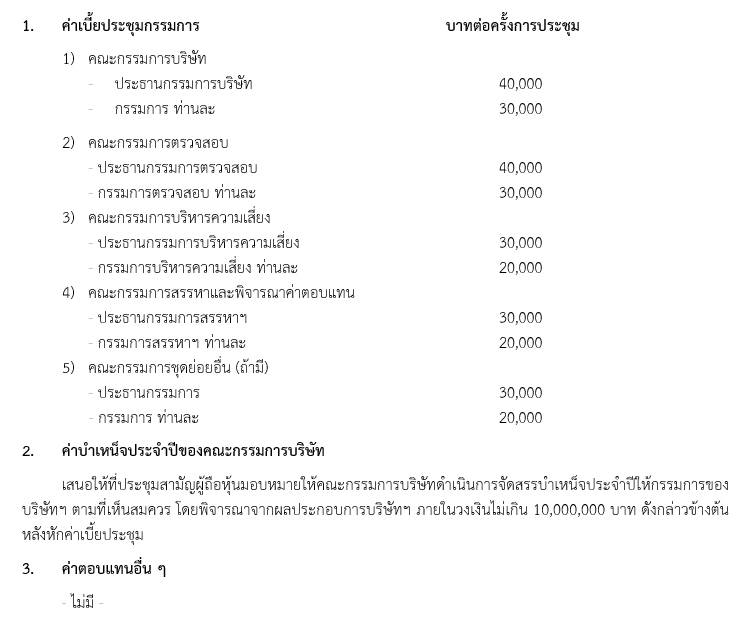
Remuneration or Benefits Payable to the Board
| Metric | Amount (Baht) |
|---|---|
| Remunerations or benefits pending payment to the board of directors over the past year (baht) | 0 |
Supervision of Subsidiaries & Associated Companies
Does the Company Have Subsidiaries or Associated Companies?
Yes
Is There a Mechanism for Overseeing Subsidiaries and Associated Companies?
Yes
Mechanism for Overseeing Management of Subsidiaries
Oversight of the Operations of Subsidiaries and Joint Ventures
This policy stipulates that any transaction or operation by a subsidiary and/or joint venture must be approved by the Board of Directors meeting and/or the Company's Shareholders' meeting (as the case may be). The Chairman of the Board is responsible for arranging a meeting of the Company's Board of Directors and/or the Company's Shareholders' meeting to consider and approve such matters before the subsidiary and/or its own shareholders' meeting (as the case may be) considers and approves the reporting or execution of such matters. In this regard, the Company shall disclose information and comply fully and accurately with the principles, conditions, procedures, and methods related to transactions or operations of subsidiaries and joint ventures as prescribed by relevant laws, as follows:
-
The Company shall appoint individuals representing the Company to serve as directors in each subsidiary, at least in proportion to the shareholding in each company, unless otherwise stipulated by this policy or the Company's Board of Directors, to oversee that the subsidiaries operate in compliance with laws, good corporate governance principles, and other policies of the Company. However, the appointment of Company representatives as directors in each subsidiary shall be at the discretion of the Company's Board of Directors, taking into account the suitability of each company.
-
If any transaction or operation by a subsidiary falls under or constitutes an acquisition or disposition of assets as per the relevant notifications regarding the acquisition or disposition of assets, or a connected transaction as per the relevant notifications regarding connected transactions, which would require the Company to seek approval from the Company's Board of Directors meeting and/or the Company's Shareholders' meeting, or approval from relevant legal authorities prior to entering into such a transaction, the subsidiary shall only enter into such a transaction or operation after receiving approval from the Company's Board of Directors meeting and/or the Company's Shareholders' meeting and/or relevant authorities (as the case may be).
Furthermore, if any transaction or event of a subsidiary requires the Company to disclose information to the Stock Exchange of Thailand according to the criteria specified in relevant notifications, the representative directors of such subsidiary are obliged to immediately notify the Company's management upon becoming aware that the subsidiary plans to enter into such a transaction or that such an event has occurred.
-
The Company shall stipulate that the board of directors and management of each subsidiary have significant duties and responsibilities as per relevant laws, such as disclosing information regarding their financial position and operating results to the Company, by applying, mutatis mutandis, the relevant notifications of the Capital Market Supervisory Board and the Stock Exchange of Thailand, as well as disclosing and submitting information on their interests and those of related persons to the Company's Board of Directors to inform them of relationships and transactions with the Company and/or subsidiaries that may give rise to conflicts of interest, and to avoid transactions that may give rise to conflicts of interest.
-
The Company shall establish necessary plans and actions to ensure that subsidiaries disclose information regarding their operating results and financial position. The Company shall also take necessary actions and monitor that subsidiaries have adequate and appropriate information disclosure systems and internal control systems for business operations, and that they submit financial reports and financial statements reviewed/audited by auditors, as well as supporting information for the preparation of such financial statements to the Company for the purpose of preparing consolidated financial statements or the Company's performance.
-
Any transaction involving the sale or transfer of all or a significant portion of a subsidiary's business to another person, and/or the acquisition or transfer of another company's business to a subsidiary, and/or any other transaction that is not part of the subsidiary's normal course of business and would significantly impact the subsidiary, must receive approval from the Company's Board of Directors meeting before entering into such a transaction. Furthermore, the Company shall arrange for approval from the Company's Shareholders' meeting if the calculated transaction size (by applying, mutatis mutandis, the criteria for calculating transaction size as stipulated in the notifications of the Capital Market Supervisory Board and the Stock Exchange of Thailand regarding the acquisition or disposition of assets, or connected transactions, and any amendments thereto currently in force) results in the Company being required to seek approval from the Company's Shareholders' meeting. In supervising the operations of subsidiaries, the scope of duties and responsibilities of the Company's Board of Directors includes:
(2) To supervise and oversee the management and various operations of subsidiaries to ensure compliance with the Company's policies.
(3) To consider appointing individuals to serve as directors of subsidiaries, at least in proportion to the shareholding in the subsidiary, including:
(4) To establish a clear framework of discretionary power for voting at subsidiary board meetings on important matters, which must receive prior approval from the Company's Board of Directors, in order to control management in accordance with the Company's policies and ensure that various transactions comply with the law.
Oversight Mechanisms
| Mechanism |
|---|
| Sending representatives to act as directors, executives or controlling persons in proportion to shareholdings |
Board Duty Performance — Overview
Board Duty Performance — Overall Description
For the year 2025, the Board of Directors considered key issues covering legal compliance in corporate governance, risk management and internal audit, organizational strategies, as well as entering into significant transactions, with details as follows:
1. Compliance with Laws and Regulations
The Board of Directors considered and approved key issues in accordance with its roles and responsibilities, such as financial statements, dividend payments, shareholder meetings, connected transactions, appointment of directors and sub-committees, as well as entering into significant company contracts, all in compliance with laws and regulatory guidelines.
2. Governance of Administration in accordance with Good Corporate Governance Principles
The Board of Directors plays a crucial role in monitoring and considering various matters to ensure operations comply with good corporate governance principles and international standards, such as ethics reports, securities trading reports by executives, reports from sub-committees, amendments or reviews of sub-committee charters, and quarterly monitoring of corporate governance performance in other areas.
3. Key Strategies and Policies
4. Supervision of subsidiaries and associated companies
The Board regularly acknowledged the operating results of subsidiaries and associated companies on a quarterly basis. Directors or senior executives from subsidiaries and associated companies attended meetings to clarify and report to the Board, as well as to propose new investment projects that require approval according to the procedures and criteria set by the Stock Exchange of Thailand and the Securities and Exchange Commission.
The quarterly Board meeting agenda will cover the following:
-
Matters for endorsement and ratification include: ratifying the minutes of the Board of Directors' meetings, and ratifying the operations of the Executive Committee.
-
Matters for acknowledgement include: Operations of the Executive Committee (as per Executive Committee meeting minutes), operations of the Audit Committee (as per Audit Committee meeting minutes), operations of the Risk Management Committee (as per Risk Management Committee meeting minutes), operations of the Nomination and Remuneration Committee (as per Nomination and Remuneration Committee meeting minutes), reporting on the disclosure of securities trading and changes in securities holdings by company directors and executive-level positions, company auditors, including individuals related to the aforementioned persons, reporting on whistleblowing and complaints, reporting on connected transactions, inter-company transactions, prevention of conflicts of interest, and reporting on interests, reporting on the progress of the company's business opportunity studies, and reporting on the progress of investments in subsidiaries.
-
Matters for consideration and approval include items that comply with laws, regulations, rules of the Stock Exchange of Thailand and the Securities and Exchange Commission, company bylaws, and items within the scope of the Board's responsibility, such as approval of transactions exceeding the Executive Committee's approval authority, material transactions affecting the company's business, and investments in new businesses.
Furthermore, the Board of Directors emphasizes the formulation and implementation of organizational strategies. It monitors and oversees the execution of defined strategies at every quarterly Board meeting, and reviews key policies such as vision, mission, organizational strategies, and Corporate KPIs to align with changing environments. Key policy formulations and investments in significant projects include expanding investments in the energy business, real estate development business, as well as new businesses in data center projects.
Audit Committee Duty Performance
Results of the Audit Committee's Duty Performance in the Past Year
In 2025, the Audit Committee held a total of 5 meetings, with all Audit Committee members attending every meeting. One of these meetings was held privately with the external auditor without the presence of management, in order to be informed of issues identified during the audit and significant matters raised by the auditor. This practice supports good corporate governance and enhances the transparency of the Company’s financial reporting. The Audit Committee also reported the outcomes of its meetings to the Board of Directors on a quarterly basis.
The Audit Committee performed its duties within the scope of responsibilities as stipulated in the Audit Committee Charter, as assigned by the Board of Directors, in alignment with best practices and the requirements prescribed by the Securities and Exchange Commission and the Stock Exchange of Thailand. Its responsibilities include the review of financial statements, related party transactions, risk management, oversight of internal audit, and compliance with applicable laws and regulations. The Committee also engaged in discussions and exchanged views with management and the internal auditor.
Key summaries of the Audit Committee's performance are as follows:
Review of Financial Reports
The Audit Committee reviewed the Company's and its subsidiaries' quarterly and annual financial statements for 2025, together with the management and the auditor. The auditor was consulted regarding the accuracy and completeness of the financial statements, the adjustment of significant accounting items to comply with financial reporting standards, accounting estimates, and the consideration of intercompany transactions or transactions that may have conflicts of interest affecting the financial statements, adequate and accurate disclosure of information, the independence of the auditor, and the auditor's observations. After consideration and review, the Audit Committee is of the opinion that the financial statements present items fairly in all material respects in accordance with financial reporting standards, and that the information disclosed is accurate, sufficient, and beneficial to financial statement users.
Review and revision of the good corporate governance structure.
The Audit Committee reviewed the good corporate governance structure to align with the guidelines of the Stock Exchange of Thailand. The company has established a management structure comprising the Board of Directors, sub-committees, and the Executive Committee, with clearly defined scopes, authorities, and responsibilities for each committee. Furthermore, the committee considered and approved various important company policies, which are documented and reviewed annually, to be announced and communicated thoroughly to directors, executives, and employees. These policies include Anti-Corruption Policy, Gift and Benefit Acceptance/Giving Policy, Personal Data Protection Policy, Insider Trading and Securities Trading Policy, and Internal Control Policy, etc.
3. Review of risk management and effectiveness of the internal control system.
The Audit Committee reviewed and monitored the company's risk management, including the effectiveness of the internal control system, to cover significant business risks in terms of strategy, operations, financial reporting, and compliance with relevant laws and regulations.
The Audit Committee considered the appropriateness and sufficiency of the processes for identifying, assessing, and managing risks, as well as the design and operation of the internal control system. This was based on information from management, internal auditors, and relevant audit results, to ensure that the company has risk management and internal control systems capable of appropriately accommodating changes in the business environment.
In 2025, the Audit Committee received 6 internal audit reports covering internal controls in strategy, operations, financial reporting, and legal compliance, namely:
Petty Cash Management Process
Workpiece Cutting and Drilling Process
Control and Utilization Process for Company and Leased Vehicles
Management and Control Process for Leased Machinery
Sale of Scrap and Waste Metal
Project Closeout Report Preparation
From the audit results, it was found that most of the deficiencies identified were operational practices that did not comply with the Company's established rules and guidelines. Management has already addressed these issues through communication and clarification with relevant personnel, and some rules and guidelines have been reviewed and improved to be more appropriate. The Audit Committee has continuously monitored the progress of these corrective actions and found no issues that significantly impact the Company's business operations.
4. Review and oversight of internal audit work.
The Audit Committee reviewed and oversaw the company's internal audit work to ensure compliance with the Internal Audit Charter, generally accepted internal audit standards, and alignment with the nature and risks of the business.
The Audit Committee considered the roles, duties, responsibilities, independence, staffing levels, and budget of the internal audit function to ensure they are appropriate and consistent with the internal audit guidelines of the Stock Exchange of Thailand. Recognizing the importance of internal audit, the Audit Committee appointed an Internal Audit Department Head with suitable qualifications in both education and work experience to manage internal audit operations. This includes approving the annual internal audit plan, which is determined based on risk assessment (Risk-Based Audit) for all significant processes of the company and its subsidiaries. The internal control system is regularly reviewed in conjunction with internal auditors, and all internal audit reports are considered according to the approved plan. The Audit Committee is of the opinion that the company has adequate and appropriate internal controls, which are continuously updated to align with changing activities, to ensure that the operations of the company and its subsidiaries achieve their stated objectives, in accordance with COSO guidelines. Furthermore, the Audit Committee has urged management to continuously improve the effectiveness of the internal control system.
5. Review of compliance with securities and exchange laws, regulations of the Stock Exchange of Thailand, the Securities and Exchange Commission, and laws related to the company's operations.
The Audit Committee considered and reviewed compliance with securities and exchange laws, Stock Exchange regulations, and laws related to the company's business. The Audit Committee found no material issues regarding non-compliance with laws, regulations, and other related laws.
6. Review of connected transactions or transactions that may have conflicts of interest.
The Audit Committee reviewed connected transactions and transactions that may have conflicts of interest, as well as reports from relevant directors. It was found that these transactions were reasonable and were disclosed to the Stock Exchange of Thailand accurately and within the specified timeframe.
7. Self-assessment of performance, both as a committee and individually.
The Audit Committee conducted an annual performance evaluation, both collectively and individually, in accordance with best practices. The results indicated that the Committee performed its duties in full compliance with its Charter and SET guidelines. The overall and individual evaluation scores averaged 4 (strongly agree / excellent performance), and the results were reported to the Board of Directors.
8. Consideration for selection, nomination, and remuneration proposal for the auditor.
The Audit Committee considered the selection, appointment, and remuneration of the external auditor for 2025, and proposed the matter to the Board of Directors for approval prior to submission to the Annual General Meeting.
The evaluation was based on performance, expertise, experience, independence, and appropriateness of audit fees for the Company and its subsidiaries. The Committee concluded that the auditors from EY Office Limited possess the necessary independence, expertise, and experience, and are able to complete audits in a timely manner with reasonable fees.
Accordingly, the Committee proposed the appointment of EY Office Limited as the Company’s auditor for 2025, with an audit fee of THB 1,900,000 for the Company. It also acknowledged audit fees of THB 5,060,000 for subsidiaries and joint venture audited by EY, and THB 242,655 by other auditors.
9. Reporting meeting results to the Board of Directors.
The Audit Committee prepares meeting minutes and internal audit evaluation reports for the Board of Directors after every Audit Committee meeting, in line with the Audit Committee's good practices.
10. Review and revision of the Audit Committee Charter.
The Audit Committee reviewed and approved revisions to its Charter and proposed them to the Board of Directors for approval on March 14, 2025. The revisions were made to ensure appropriateness and alignment with current responsibilities.
In summary, for the year 2025, the Audit Committee fully performed its duties in accordance with the charter approved by the Board of Directors. The Committee is of the opinion that the Company maintains good corporate governance, financial statements prepared according to financial reporting standards, accurate, complete, and sufficient disclosure of information in financial reports, appropriate internal controls, adherence to business ethics, and compliance with relevant rules and laws, consistent with the principles of the Securities and Exchange Commission and the Stock Exchange of Thailand.
Executive Committee Duty Performance
Results of the Executive Committee's Duty Performance in the Past Year
In 2025, the Executive Committee fulfilled its duties and responsibilities assigned by the Board of Directors in setting policies, directions, and business strategies, as well as reviewing financial plans, investment plans, business operating plans, and other management tasks. This was to ensure that the company's management operates efficiently, with adequate and appropriate control over various management guidelines as stipulated, and conducts business in compliance with the law. The focus was on ensuring the company operates according to good corporate governance principles, in line with the announcements of the Stock Exchange of Thailand and its best practices. The Executive Committee held a total of 20 meetings, summarizing key activities in reports presented to the Board of Directors on various matters as follows:
1. Setting annual policies, directions, and strategies The Executive Committee, led by the Chairman of the Executive Committee, has set policies, directions, and operational strategies to prepare for changes throughout 2025. The company remains committed to conducting business with transparency, fairness, integrity, and impartiality, in accordance with ethical principles and work ethics.
2. Review of business operating plans The Executive Committee has overseen and reviewed business operating plans, financial plans, investments, budgets, and other management tasks proposed by the management, ensuring adherence to good corporate governance principles.
3. Monitoring business policies and strategies The Executive Committee has consistently monitored and reviewed the company's operations in accordance with its business policies, strategies, and various management guidelines, as stipulated, to ensure efficient business operations and to provide adequate and appropriate reports to the Board of Directors.
4. Providing advice and consultation
The Executive Committee has provided advice, consultation, and assigned guidelines for management and business operations to the management, as well as overseeing and reviewing financial plans, investments, and budgets for the Accounting and Finance Manager, and any business operations that bind the company. This also includes conducting feasibility studies and offering advice or recommendations for participating in tenders or investing in new projects.
5. Oversight of financial plans and performance evaluation
The Executive Committee has overseen and reviewed financial and investment plans, including approving the opening and closing of various accounts or requesting various forms of credit from all banks or financial institutions, and reported these to the Audit Committee. Furthermore, the Executive Committee has also participated in evaluating operational performance.
The Executive Committee has fully performed its duties within the scope of authority approved by the Board of Directors and is of the opinion that the company's management adheres to good corporate governance, maintains effective management standards in business operations, finance, marketing, and other administrative functions, and operates in accordance with established policies and strategies. Furthermore, it upholds business ethics and complies with relevant regulations and laws, consistent with the criteria of the Securities and Exchange Commission (SEC) and the Stock Exchange of Thailand (SET).