Risk Management · 2025
In this section2 topics
Risk Management Policy & Plan
Policy & Plan Description
Policy and Risk Management Plan
STP & I Public Company Limited recognizes that risk management is an integral part of good corporate governance, which is a crucial foundation enabling the company to achieve its objectives. The company has established its Risk Management Policy and Risk Management Framework in accordance with the COSO Enterprise & Risk Management – Integrating with Strategy and Performance (2017) concept, as follows:
The Risk Management Committee has defined the scope and definition of the company's risks, clearly identifying 8 main groups of risks: Strategic Risk, Financial Risk, Operational Risk, Compliance Risk, Cyber Risk, Organization Risk, External Risk, and Corruption Risk. All executives and employees within the organization are risk owners and must be aware of the risks present in their respective departments and the organization as a whole.
The Risk Management Committee establishes good and sufficient guidelines or measures for risk management, capable of identifying, assessing, prioritizing, and defining the company's risk factors based on a two-dimensional risk assessment: the likelihood of an event and the severity of its impact. It sets acceptable risk levels (Risk Appetite) as low, medium, high, and very high, and implements risk response methods, reporting, monitoring, and continuously evaluating results throughout the organization.
The Risk Management Committee requires management to present high and very high-level risks with details. In the past year 2568, there were two significant risks: financial risk related to liquidity (Liquidity Risk) and strategic risk related to revenue volatility arising from the uncertainty of awarded bidding projects, as well as other risks mentioned under the topic of risk factors affecting the company's business operations.
The Risk Management Committee monitors and thoroughly evaluates the Mitigation Plan at quarterly meetings and presents it to the Audit Committee and/or the Board of Directors, as appropriate.
The Risk Management Committee reviews performance and changes in risks that may affect business strategies and objectives, and continuously improves the organization's risk management.
The Risk Management Committee promotes and supports the use of risk management as a crucial tool, requiring communication to ensure understanding among all levels of personnel and mutual cooperation to enhance good corporate governance and build confidence among stakeholders.
The Risk Management Committee has the following steps and guidelines for risk management:
The Risk Management Committee identifies all types of risks that may impact business operations, finances, and relevant regulations and laws.
The Risk Management Committee analyzes and assesses risks by considering both the likelihood of an event occurring and its potential impact.
The Risk Management Committee defines measures and action plans to manage risks, which may involve accepting the risk, reducing the risk, avoiding the risk, or sharing the risk.
The Risk Management Committee considers control measures to align with operational plans at all organizational levels, including group companies, business units, departments, sections, or processes, ensuring suitability with the risks and specific characteristics of the organization, such as environment, work complexity, nature of work, scope, and operations.
The Risk Management Committee monitors and reviews control effectiveness to ensure that control measures are fully and appropriately implemented.
Further details regarding the “Risk Management Policy” can be found on the company's website: https://www.stpi.co.th/wp-content/uploads/2024/03/Risk-Management-Policy-2024.pdf
Policy Document Link
https://www.stpi.co.th/wp-content/uploads/2024/03/Risk-Management-Policy-2024.pdf
Risks to the Company's Business Operations
Risk Register
| Risk Name | Risk Characteristics | Consequences | Management Measures | Related Risk Factors |
|---|---|---|---|---|
| Strategic Risk - Risk from revenue volatility | The company generates revenue from steel structure fabrication, pipe assembly and welding, and pre-fabricated plant assembly, which are make-to-order productions based on customer specifications. As the company's revenue generation depends on its ability to secure projects through bidding to customers and the inherent uncertainty of tendered projects, which may experience delays, the company's revenue fluctuates according to the volume of projects it successfully bids for. Therefore, in the future, if the company is unable to secure bids or does not receive projects due to delays in the customers' own projects, it will directly impact the continuity of the company's revenue, as well as potentially reduce the gross profit margin during periods when the company's revenue is insufficient to cover fixed costs. | The impact of future revenue volatility, should the company be unable to secure bids or receive work due to delays in clients' own projects, will directly affect the continuity of the company's revenue. This also includes a potential reduction in gross profit margins during periods when the company's revenue is insufficient to cover fixed costs. | Due to the risk of income volatility, the company has a policy to maintain income continuity by expanding investments as follows: In 2016, the company acquired 60% of the ordinary shares of WPGE Phetchaburi Company Limited ("WPP") from its former shareholders to operate a municipal waste-to-energy business with a total installed capacity of 7.9 megawatts. A power purchase agreement for 5.99 megawatts has been signed with the Provincial Electricity Authority, which will expand the business into the growing renewable energy sector, in line with the Alternative Energy Development Plan B.E. 2558 (2015), and generate recurring income for the group in the long term. In 2017, the company expanded its real estate development and logistics businesses by establishing ST Property and Logistics Company Limited ("STP&L") and acquiring land and buildings with long-term lease agreements, allowing for immediate revenue recognition. In 2019, ST Property and Logistics Company Limited ("STP&L") (a 100% subsidiary) acquired 100% of the ordinary shares from the former shareholders of Boutique Phra Khanong One Company Limited and Boutique Phra Khanong Two Company Limited. These companies operate office building rental and shopping center rental businesses with nearly 100% occupancy, allowing for immediate recognition of revenue from rental agreements. The companies were subsequently renamed ST Hill Company Limited and ST Hub Company Limited, respectively. In 2020, STP&L acquired vacant land and long-term lease rights for approximately 30 years along Bangna-Trad Road at Km. 19 and Km. 22. These locations have potential for commercial development and are designated as purple zones, allowing for industrial and warehouse land use. Both plots of land are currently under negotiation with tenants for the construction of buildings tailored to customer needs, with long-term lease agreements. The group remains committed to continuously expanding its real estate development business. In April 2022, ST Property and Logistics Company Limited ("STP&L") acquired 90% of the ordinary shares from the former shareholders of Growth Warehouse Company Limited, which operates a warehouse rental business, to expand its real estate development and logistics businesses in the Northeast. In May 2022, the company, in collaboration with PowerVolt (Thailand) Company Limited, established Sinopower Company Limited with a 60% shareholding to operate renewable energy businesses, including Solar Roof and Solar Farm. In January 2023, the company invested in the 600-megawatt Monsoon Wind Power Project of Monsoon Wind Power Company Limited ("MWPCL") in the Lao People's Democratic Republic, which operates the business of generating and selling electricity under a power purchase agreement with Electricity of Vietnam. ST Clean Planet (Asia) Company Limited ("STCPA") was established to invest in and acquire ordinary shares of Impact Monsoon Holdings Limited ("IMH"). Following the acquisition of shares in IMH, the company will become the ultimate shareholder with a 15.87% stake in the paid-up registered capital of MWPCL. The project is currently under construction and is expected to start recognizing revenue around early 2025. In December 2023, the company invested 50% in the solar power generation business of Impact Solar Group Limited ("ISG"), making the company the ultimate shareholder with a 50% stake in the paid-up registered capital of Impact Solar Group (Thailand) Company Limited ("ISGT") and a 25.52% stake in the paid-up registered capital of Impact Solar Company Limited ("ISL"). Both companies have power purchase agreements (PPAs) for a total installed capacity of 106 megawatts, allowing for immediate recognition of profits proportionate to the shareholding. In September 2024, the company expanded its investment in the solar power generation business by acquiring all shares of ISGT from ISG, resulting in the company holding 100% and 51.04% stakes in ISGT and ISL, respectively. Consequently, ISGT and ISL became subsidiaries of the company, requiring consolidated financial statements. Therefore, revenue from electricity sales and related services will be recognized in the company's consolidated financial statements starting from September 2024 onwards, which will contribute to increasing recurring income for the group in the long term. The company continues to focus on providing fabrication services for modular plants in the LNG industry, which is a crucial global energy source with ongoing growth opportunities. The company is committed to producing high-quality, standardized work and delivering projects on time to ensure customer satisfaction, thereby fostering strong relationships for continuous project assignments. However, there are still risk factors from the impacts of the Ukraine-Russia war and conflicts in Israel, which may affect the company's target projects. Simultaneously, economic stimulus policies in several countries and increasing energy demand from domestic production within EU and American countries, along with new projects addressing environmental changes and zero-carbon policies in many nations, continue to drive significant new investments requiring steel structures, piping work, and modular plants. The company will closely monitor project situations and clients to be prepared when projects receive investment approval or commence operations. The company will continue to focus on the decommissioning of offshore oil and natural gas platforms, particularly concession platforms in the Gulf of Thailand, several of which began decommissioning in 2023 according to concessionaire plans and the Department of Mineral Fuels' plans. This sector has few competitors. The company has secured contracts for cutting and dismantling a number of platforms and their legs, with operations commencing in mid-2022 and continuing to the present. The company also continues to participate in bids for several other platform dismantling projects, including those with other clients, indicating a consistently positive outlook for securing continuous work of this type. In addition, the company has increased the proportion of recurring income by expanding investments in both PPA and Solar Farm businesses, as well as expanding its warehouse rental business. | 737 · Other name: 1.1 Risk of Income Volatility · Description: Other · Info category: STRATEGIC_RISK |
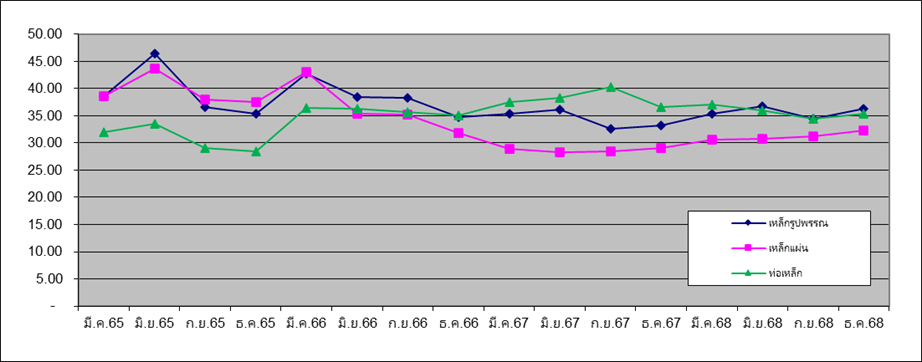
| Operational Risk - Shortage or price volatility of raw materials or production inputs | The Company utilizes structural steel, steel plates, and steel pipes as primary raw materials for manufacturing steel structure fabrication and pre-fabricated plant assembly. The Company addresses the risk of raw material price fluctuations by monitoring steel prices in markets across Asia, Europe, and the United States, as well as domestic steel prices. If a project awarded to the Company has a duration exceeding one year, particularly for pipe assembly and welding work, where steel pipes and fittings are primary raw materials and are quality-grade steel that relies on imports and is relatively more difficult to procure than structural steel in terms of sourcing and price control, the Company proposes to undertake projects from clients by negotiating for the clients to supply the raw materials, specifically steel pipes and fittings for piping systems. For the year 2025, raw material procurement is approximately 23% from domestic manufacturers or distributors and approximately 77% is imported from abroad. The imported raw materials primarily originate from the Middle East and China. | direct impact on the company's production costs. The prices of key raw materials have been monitored from 2020 to the present to inform decision-making aimed at mitigating these impacts. Over the preceding period, the changes in the prices of structural steel, steel plates, and steel pipes are as follows:
Source: Price data for structural steel and steel plates purchased domestically by the company.
For 2024-2025, the company has primarily procured its main steel raw materials from countries in the Middle East. This involves negotiating prices, terms, and delivery conditions to achieve maximum benefit for the company. These suppliers have sufficient stock readily available for timely delivery within short periods. Furthermore, the company closely monitors the situation to enable timely and optimal adjustments to procurement plans and to effectively control raw material costs. | The company will endeavor to negotiate and agree on raw material procurement contracts with suppliers, fixing prices for the entire project duration, particularly for imported steel, which constitutes a significant proportion of the raw materials used in project work. This is to mitigate price risks that may fluctuate according to market prices. However, this depends on market conditions and manufacturers' costs at those times, which may be difficult to control. The company has foreseen that it can manage and control the costs of these raw materials to ensure profitability. Therefore, the company has proposed undertaking projects from clients where the company will procure the raw materials itself, specifically structural steel, steel plates, and steel pipes for the structural work. For the procurement of steel, which is the primary raw material for project manufacturing in 2025, where most projects require the use of international grade steel, the company has assessed the raw material cost situation at the beginning of the project and the price trends during the project's duration. Compared to the project's budgeted prices, the market prices for raw materials during that period were within a relatively stable range with minor fluctuations. Furthermore, due to the slowdown in the Chinese economy, there was an oversupply of raw materials domestically, resulting in relatively low prices for raw material imports from China. Currently, ongoing projects do not have restrictions on using steel raw materials produced and imported from China. Additionally, the war situation over the past year has affected shipping, leading to increased sea freight costs and longer delivery times. Focusing on manufacturers in the East, China, and Southeast Asia to mitigate the impact of such situations is therefore crucial. The company therefore considers steel raw material procurement with the utmost prudence, finalizing purchases on a case-by-case basis immediately upon receiving purchase requisitions, to reduce the risk of fluctuating or potentially decreasing future costs. To achieve this, the company has benchmarked prices from at least 3-5 domestic and international manufacturers and distributors to foster competition and secure the best possible cost. The company will continue to monitor and evaluate market price situations and meticulously plan subsequent procurement. In 2025, various construction projects currently undertaken by the company are in their initial stages. This results in large quantities of steel raw material being ordered in each procurement. Consequently, the company possesses enhanced bargaining power when negotiating with manufacturers or distributors, particularly for structural steel and steel plates, which are planned for use in substantial volumes. Furthermore, current projects do not prohibit the import of steel raw materials produced in China. This expands the options for sourcing new manufacturers and distributors and enhances opportunities for negotiating both prices and delivery terms. Regarding pipe procurement, although it can also be imported from China, the quantities ordered are not substantial, thus limiting bargaining power. While domestic manufacturers can produce and deliver more quickly than imports, their overall prices are generally higher than imported alternatives. Therefore, the company assesses the suitability of each purchase by considering price, which directly impacts project costs, delivery time to ensure timely supply of steel raw materials for production plans, and various other conditions. This comprehensive approach aims to maximize benefits for the company, coupled with close monitoring of the situation to enable timely and appropriate adjustments to procurement plans. | 740 · Description: Shortage or fluctuation in pricing of raw materials or productive resources · Info category: OPERATIONAL_RISK |
| Operational Risk - Shortage of or reliance on skilled labor | The risk of labor shortage and the inability to procure labor in time for received project work, due to a decrease in the labor pool or workers potentially seeking employment abroad. The situation over the past 2-3 years can be summarized as follows: In 2022, the labor situation in the construction sector continued to face shortages, particularly for skilled workers. This was due to several large-scale domestic construction projects resuming simultaneously after the COVID-19 pandemic began to subside, leading to high demand for labor and consequently keeping labor costs at an elevated level. In 2023, the labor situation in the construction sector continued to experience shortages, especially for skilled workers. This was attributed to the ongoing progression of several large-scale domestic construction projects, as well as the reopening of Middle Eastern countries that sought Thai construction workers. Furthermore, while the company accelerated its project work, it could not procure labor quickly enough to meet demand. Consequently, there was an increased reliance on subcontractors for short-term acceleration of work, which also contributed to labor costs remaining at a high level. In 2024, during the period awaiting large-scale projects, the recruitment of labor was not extensive. The existing labor force was sufficient for the current workload, thus posing no significant issues regarding labor shortages. In 2025, there will be a high demand for labor due to the need to accelerate progress on large-scale projects that the company must complete by early 2026. This necessitates the hiring of labor across all sectors, particularly skilled labor. The company has implemented a policy of providing allowances and cumulative project completion bonuses to minimize labor shortages and focuses on short-term engagement of subcontractors to supplement project labor and manage costs effectively. | The inability to procure labor in a timely manner to meet demand necessitates an increased reliance on contractors to expedite work during short periods. This results in labor costs remaining high and may lead to issues with delayed project delivery, potentially incurring penalties from clients. | Furthermore, the company has invested in machinery over the past 2-3 years to replace long-term labor and enhance operational efficiency. The company will focus on developing specialized labor groups to address potential labor shortages, particularly skilled workers with experience in steel structure fabrication, which is a task that cannot yet be replaced by machinery. It is also necessary to manage and develop existing labor to be more capable and versatile, and to accelerate the development of new labor to possess sufficient skills for the company's operations. Additionally, the company has procured and utilized foreign labor for its project work, which has significantly supported the company's operations, thereby increasing the company's workforce. Most importantly, the company will manage employee compensation to create incentives, including project-based special payments and continuous work until project completion, as well as building confidence among workers regarding employment with a company that has an excellent safety management system. In 2025, the company must rapidly plan for an increase in labor recruitment to meet demand. The company has proactively communicated with labor groups and contractors through various online media. The company is confident that it can still secure sufficient labor, both Thai and foreign, and must increasingly seek new sources of labor. However, there might be an impact from rising labor costs, but this remains at a manageable level, as the company has considered such risks since the bidding stage. | 739 · Description: Shortage or reliance on skilled workers · Info category: OPERATIONAL_RISK |
| Exchange rate volatility | Exchange rate fluctuations are considered a significant risk related to the company's financial and investment management policies and procedures, as the majority of revenue is derived from exports denominated in US Dollars (USD), and expenses are incurred in both Thai Baht and foreign currencies, in addition to foreign investments. | Exchange rate fluctuations affect the company's operating results and financial statements, including the impact on performance failing to meet established targets, as well as the risk of liquidity shortages. | The company consistently maintains a policy for managing foreign exchange rate risks. Given that the company engages in the buying and selling of goods or services and makes payments in foreign currencies, it will utilize forward foreign exchange contracts (Forward Contracts) and foreign exchange options (FX Options) with commercial banks to mitigate risks. This approach is implemented in conjunction with considering the strategy of matching revenues and expenses denominated in the same foreign currency. | 764 · Description: Fluctuation in exchange rates, interest rates, or the inflation rate · Info category: FINANCIAL_RISK |
| Credit Risk | The company faces credit risk from the possibility that customers may not be able to pay for goods and services as scheduled, particularly trade receivables arising from large-scale steel structure manufacturing and installation projects, which often involve high contract values and relatively long credit terms according to contract conditions. Furthermore, the company may face risks from customer concentration in certain industries, such as the energy, oil and gas sectors, or large construction projects. Should these industries be affected by economic conditions or fluctuations in energy prices, it could impact the customers' ability to make payments. | The nature of the company's business operations, particularly projects where revenue is recognized based on work progress and payments are collected in installments (Milestone Payment), including potential deductions for performance guarantees (Retention), exposes the company to risks of delayed collections or customers being unable to make payments according to the specified terms, which could impact the company's cash flow and liquidity. |
| 767 · Other name: Credit Risk · Description: Other · Info category: FINANCIAL_RISK |
| Interest rate volatility | The company is exposed to risks from interest rate fluctuations, which may impact its financial costs and operational performance, especially if the company has loans with floating interest rates ( Floating Rate) or has borrowed funds for investment and project operations. | The increase in market interest rates may significantly increase the company's financial costs, which could impact profitability, cash flow, and the ability to comply with financial covenants ( Covenants) stipulated in loan agreements | The company has established guidelines for managing interest rate risk as follows:
| 764 · Description: Fluctuation in exchange rates, interest rates, or the inflation rate · Info category: FINANCIAL_RISK |
| Liquidity risk in business operations | Due to the nature of the large-scale steel structure fabrication business, which involves relatively long production periods and payment collection cycles, some projects stipulate payment collection upon delivery of goods and related documents. There may be a deduction for performance retention (Retention), or the final payment may only be collected upon the expiration of the performance warranty (Warranty). Consequently, operating cash flow may not align with payment obligations, particularly for raw materials and production costs that require upfront payment. Therefore, a significant proportion of working capital is required. In addition, the Company may face risks from delays in project delivery, which could result in the inability to collect payments according to the planned milestones, or from some customers failing to pay for goods on time, thereby impacting cash flow and overall operations. | Liquidity problems may lead to delays in payments to partners, thereby damaging business relationships. Furthermore, the company may be compelled to borrow funds or reallocate resources from other areas for each project, potentially incurring interest expenses or opportunity costs in the utilization of financial resources. Additionally, inefficient cash flow management could adversely affect the company's reputation among stakeholders, including investors and partners. |
| 1724 · Description: Liquidity risk · Info category: FINANCIAL_RISK |
| Operational Risk - Work Systems or Internal Control Systems | The company's business operations involve processing tasks that are highly specialized in each process, requiring knowledge, expertise, and specialized skills from personnel in performing the work. If the design of work processes, operational standards, manuals, or operational support systems are not aligned with the specialized nature of the business, it may lead to operational errors, inconsistent quality, as well as the risk of over-reliance on individual specialized personnel. | This results in internal organizational impacts, including inefficient operations, a lack of operational continuity, compromised product and service quality, increased operational costs, reduced workplace safety, and diminished stakeholder confidence. Furthermore, it may lead to compliance risks with relevant regulations and standards. | The Company has established operational risk management measures by adopting the ISO 9001:2015 Quality Management System framework as a guideline for designing and developing work processes. This includes the creation of manuals, regulations, and operational procedures that are stringent and appropriate for specialized tasks. The aim is to establish clear operational standards, reduce errors, and ensure consistent quality. Additionally, there are operational standards specifically defined by clients for each project. These standards are subject to annual audits by independent organizations, or pre-implementation audits by clients and independent bodies of the respective projects. Additionally, the Company has mandated operational verification by personnel at each significant step of the work process, encompassing both self-inspection and verification by relevant parties. This aims to detect errors from an early stage and mitigate risks that could impact the quality and outcomes of the work. Concurrently, the Company emphasizes internal audits of core processes, which involve establishing audit plans, monitoring results, and reporting findings to management. The purpose is to assess the suitability and effectiveness of internal control processes and support continuous improvement of work processes. The Company is also inclined to study and prepare for the adoption of the revised ISO 9001:2026 standard to elevate its management system in line with future business contexts and directions. In the area of information technology, the Company has developed and designed information systems to support its unique business operations, which differ from general businesses. Concurrently, stringent and robust internal control measures for information systems and IT security have been established, such as access control, data change control, data integrity maintenance, and data backup. These measures aim to efficiently support operations, performance monitoring, and management decision-making. Furthermore, management plays a role in regularly overseeing, monitoring, and reviewing the effectiveness of these risk management measures. This is to ensure that the Company's operational risk management is appropriate, aligns with the nature of its business, and supports the sustainable achievement of organizational objectives. | 741 · Description: Systems or internal control system · Info category: OPERATIONAL_RISK |
| Regulatory Risks - Regulatory Risks | This is a risk arising from non-compliance with laws, regulations, rules, announcements, orders, criteria, and guidelines, both of the Company and external agencies. It also includes cases where established regulations are unclear, requiring discretion or interpretation. This covers risks related to compliance with regulations and rules of regulatory bodies, and risks related to various laws pertaining to the Company's business operations. In this regard, the Company has regularly complied with the established criteria. Furthermore, since most of the Group's work involves providing services under contracts, the Company also engages subcontractors occasionally as required by each project. | Impact leading to disputes, lawsuits, or complaints, which can result in damages, expenses, and operational disruptions. | When entering into such contracts, various conditions will be carefully considered. However, there remains a risk that contracting parties may interpret the contractual terms differently or properly exercise contractual reservations of rights. Should the contracting parties be unable to negotiate and resolve disputes between themselves, even after making full efforts, legal methods as agreed upon in the respective contracts must be resorted to, such as submitting a claim to an arbitration office or a court of justice under applicable law, to reach a resolution. | 760 · Other name: Regulatory risks · Description: Other · Info category: COMPLIANCE_RISK |
| Cyber Risk - Data or Computer System Security and Cyberattacks | This represents a cybersecurity risk arising from changes in information technology, including digital transformation, which affects the company's operations. It pertains to the secure storage of data, the complete and timely backup of information, and the safe utilization of electronic communication systems. | Direct impact on the company's operations due to work disruption and the loss of critical company data, which will damage its reputation and result in high costs for cybersecurity problem resolution. | The Company has established an information technology system by defining an information technology computer system security policy, which is disclosed on the Company's website www.stpi.co.th. Access rights and procedures for the information system are defined, and operational guidelines for information usage, such as email and internet usage, are in place. There are also practices for information technology system administrators and guidelines for preventing and managing the information system in the event of unforeseen incidents. This is to ensure that the Company's information system has a cybersecurity risk prevention system and can be managed in a timely manner when unforeseen incidents occur. Furthermore, the Company also utilizes Data Center services from external entities, which helps reduce the risks of the information technology system. The Company therefore believes that the management of its information technology system will support the smooth operation and management of the Company's business and various activities. | 744 · Description: Information security and cyber-attack · Info category: OPERATIONAL_RISK |
| Emerging risk - Technological changes | The rapid advancement and transformation of technology in the construction, energy, and real estate sectors, such as modern construction technology, renewable energy, energy storage systems, smart building technology, the adoption of AI within companies, and new data center cooling systems, may render the company's business models or invested assets unable to effectively respond to future competitive conditions. |
|
| 732 · Description: Changes in technologies · Info category: STRATEGIC_RISK |