

CG Policy · 2025
In this section7 topics
Corporate Governance Policy
Has a Corporate Governance Policy
Yes
Policy Description
STP&I Public Company Limited recognizes the importance of good corporate governance, believing that good corporate governance will enhance excellence in both operational processes and management processes, which will elevate the company's performance to be credible to investors and stakeholders, as well as maximize shareholder value. Therefore, the company has established a written corporate governance policy, as detailed in the attached Good Corporate Governance Policy, adhering to the principles of good corporate governance as outlined in the Good Corporate Governance Principles for Listed Companies 2017 of the Securities and Exchange Commission (SEC) (CG CODE), to serve as a guideline for the Board of Directors in overseeing the company to achieve good long-term performance, credibility for shareholders and investors as a listed company on the Stock Exchange of Thailand (SET).
In this regard, the Company is committed to conducting business efficiently, operating with ethics, engaging in business that benefits society, developing or reducing negative impacts on the environment, and adapting appropriately to changes in business conditions.
The Good Corporate Governance Principles were revised and approved by the Board of Directors Meeting No. 6/2568 on December 12, 2568, and became effective from December 12, 2568. These principles have been communicated to directors, executives, and employees. The Board of Directors places importance on adhering to the principles of good corporate governance, covering 8 principles of corporate governance as follows:
Principle 1 Recognize the role and responsibilities of the Board as organizational leaders who create sustainable value for the business (Establish Clear Leadership Role and Responsibilities of the Board)
Principle 2 Define objectives and key goals for the business that promote sustainability (Define Objectives that Promote Sustainable Value Creation)
Principle 3 Strengthen Board Effectiveness
Principle 4 Recruit and develop senior executives and manage personnel (Ensure Effective CEO and People Management)
Principle 5 Promote innovation and responsible business practices (Nurture Innovation and Responsible Business)
Principle 6 Ensure appropriate risk management and internal control systems are in place (Strengthen Effective Risk Management and Internal Control)
Principle 7 Maintain financial credibility and information disclosure (Ensure Disclosure and Financial Integrity)
Principle 8 Support engagement and communication with shareholders (Ensure Engagement and Communication with Shareholders)
Details of the “Good Corporate Governance Principles” as presented in Annex 5: Full Corporate Governance Policy and Guidelines, and Full Business Ethics, which the company has prepared and published on its website https://www.stpi.co.th/investor-relations/corporate-governance/
The Board of Directors places importance on internal control and internal audit. In particular, the Board of Directors has jointly assessed the adequacy of internal controls annually since 2002 and oversees the operations of the management by requiring the Executive Committee to conduct business efficiently in accordance with policies, ensuring the company adheres to good corporate governance principles and discloses complete information as per the guidelines of the Stock Exchange of Thailand, with reports available in both Thai and English on the company's website.
The Board of Directors also emphasizes the correct and complete performance of duties by directors, by establishing sufficient sub-committees to fully carry out their responsibilities, which will lead the organization to continuous and stable growth. Currently, there are a total of 4 sub-committees, namely:
1. Executive Committee
2. Audit Committee
3. Nomination and Remuneration Committee, and
4. Risk Management Committee
The Board of Directors has also reviewed the principles of good corporate governance, business ethics, social responsibility policy, anti-corruption and bribery policy, gift/benefit acceptance/giving policy, risk management policy, personal data protection policy, insider trading and securities trading policy, human rights policy, information technology system security policy, whistleblowing policy and whistleblower protection measures, related party transaction policy, inter-company transactions, prevention of conflicts of interest and disclosure of interests, policy and guidelines for preventing corruption in procurement, and internal control policy, in accordance with the resolution of the Board of Directors Meeting No. 6/2568 on December 12, 2568, and these are important policies disclosed on the company's website. www.stpi.co.th and the Company's Web Intranet. The Company has also sent emails and posted various policies, which have been reviewed by the Board of Directors, to communicate them to directors, executives, and employees as guidelines for operations. These policies are emphasized at executive committee meetings at least once a year or when there are significant changes. The performance of the Board of Directors, individual and collective sub-committees, and the CEO's performance are evaluated at least once a year, as resolved at the Board of Directors Meeting No. 6/2568 on December 12, 2568. Furthermore, the Board of Directors and sub-committees have reviewed the charters of the Board of Directors, Audit Committee, Risk Management Committee, and Nomination and Remuneration Committee at least once a year.
Policy Document Link
https://www.stpi.co.th/investor-relations/corporate-governance/
Policy & Practices — Board of Directors
Has Policy & Guidelines for the Board
Yes
Board Guidelines
| Guideline | Other — Please Specify | Detail |
|---|---|---|
| Nomination of Directors | The Nomination and Remuneration Committee has established criteria, recruitment processes, and procedures for proposing director appointments, and has also prepared a director skills matrix (as detailed in the director skills matrix) to consider the qualifications of directors suitable for the company's board structure. Furthermore, a Director Pool database is utilized for considering new director nominations and proposing them to the Board of Directors for consideration or seeking approval for appointment at the shareholders' meeting in accordance with the company's articles of association. This consideration of suitability includes the qualifications of both current and future directors. Additionally, the company has provided an opportunity for its shareholders to propose agenda items for the Annual General Meeting of Shareholders and to nominate individuals with suitable qualifications to serve as company directors in advance for the Annual General Meeting in 2025, in accordance with the company's regulations regarding shareholders' right to propose agenda items for the Annual General Meeting in advance and to nominate individuals with suitable qualifications to serve as company directors. The company has published an announcement on its website at www.stpi.co.th On December 11, 2024, minority shareholders were notified to nominate suitable candidates for the company's board of directors by January 10, 2025. Upon the deadline, no shareholder nominated any individual as a company director. Furthermore, the company has developed a succession plan for the Managing Director and executives (positions subordinate to the Managing Director) to prevent personnel shortages in critical positions. The objective of developing a succession plan is to ensure continuous organizational management and operations. The succession plan policy will help assure shareholders and stakeholders of the organization's efficient human resource management system, leading to continuity that aligns with the business direction and the organization's future environment sustainably. Assign the Nomination and Remuneration Committee the responsibility of developing a succession plan for the Managing Director, a position critical to business operations, including defining qualifications and recruitment criteria, which comprises the following steps:
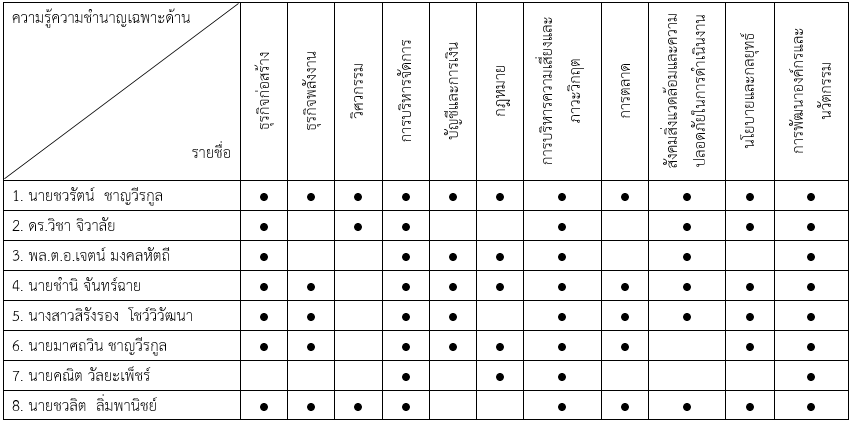
In 2025, the company continuously monitored performance, and the management has already reported the performance results to the Nomination and Remuneration Committee for acknowledgment. The Nomination and Remuneration Committee considered the skills and expertise of the directors (Board skill matrix), summarized in the following table:
Succession Plan for Managing Director and Senior Executives. Assign the Nomination and Remuneration Committee the responsibility of developing a succession plan for the Managing Director, a position critical to business operations, including defining qualifications and recruitment criteria, which comprises the following steps:
In 2025, the company is in the process of implementing the plan. However, due to the company's ongoing consideration of organizational restructuring to support the expansion of its energy and warehousing businesses, some operations have been delayed beyond schedule. | |
| Determination of Director Remuneration | The Nomination and Remuneration Committee has established criteria and methods for determining the remuneration of company directors and sub-committee members. In cases where a company director is assigned additional duties and responsibilities, such as serving as an audit committee member, they will receive remuneration commensurate with the increased duties and responsibilities assigned. This must be considered in conjunction with surveys of director remuneration in similar businesses, the company's size, and its financial capability, prepared by the Stock Exchange of Thailand and the Thai Institute of Directors Association. Such remuneration is at an appropriate level, sufficient to attract and retain qualified directors, and will take into account fairness and appropriateness for the payment of director remuneration in line with the performance of each director. This will then be submitted to the Board of Directors for consideration as assigned, before being presented to the shareholders' meeting for approval. The policy and structure for monetary remuneration of directors and sub-committee members involve paying directors and sub-committee members based on the performance of each director. Allocations are considered in accordance with the remuneration policy within a budget of 10 million Baht, which was approved by the Annual General Meeting of Shareholders for 2025 on April 28, 2025. The remuneration allocated within this budget includes meeting allowances and bonuses. | |
| Independence of the Board of Directors from the Management | With the company's board structure, it is considered independent from management. Sub-committees are appointed to perform certain tasks as necessary and systematically, to oversee the business in accordance with laws, objectives, and company regulations. The scope of duties for the Board of Directors, the Executive Committee, the Managing Director, and management has been clearly defined within the principles of good corporate governance. In 2025, there were no conflicts between the directors and management. Furthermore, the Board of Directors mandates regular meetings of non-executive directors at least once a year to foster independent development and improvement of the company's operations. | |
| Director Development | The Board of Directors has a policy to continuously promote and develop the knowledge, skills, and perspectives of directors. This enables directors to lead the organization in achieving the company's established objectives and to appropriately apply various knowledge for maximum efficiency and effectiveness in management. All directors have completed training courses related to director duties, such as the Director Certification Program (DCP) or Director Accreditation Program (DAP), organized by the Thai Institute of Directors Association (IOD). The Nomination and Remuneration Committee oversees, supports, and promotes the continuous training and development of necessary knowledge for the company's directors. Furthermore, the Board of Directors also promotes and supports the continuous development and enhancement of knowledge and experience for the Managing Director and senior executives, which are beneficial for ongoing management, in order to achieve the company's objectives and goals. | |
| Board Performance Evaluation | 1. Board of Directors Performance Evaluation In 2025, the Nomination and Remuneration Committee considered and reviewed the self-assessment forms for the Board of Directors, sub-committees, and the CEO's performance evaluation. The forms used by the company for evaluation comply with the corporate governance policy for Thai listed companies. The committee proposed approval for using the evaluation format of the Thai Institute of Directors (IOD) as the primary tool for the self-assessment of individual Board members, incorporating some relevant and beneficial topics from the Stock Exchange of Thailand's evaluation form to assess director performance. The IOD format is also used for the self-assessment of individual directors and all sub-committees. The Nomination and Remuneration Committee deemed this approach suitable for the company to use as a guideline for monitoring the performance of the Board of Directors, which was approved at the Board of Directors Meeting No. 6/2025 on December 12, 2025. The performance evaluation of the Board of Directors includes both collective and individual (self-assessment) evaluations, with details as follows: • Performance evaluation of the entire Board of Directors The evaluation is divided into 6 items according to the guidelines of the Stock Exchange of Thailand: 1. Board structure and qualifications, 2. Board roles, duties, and responsibilities, 3. Board meetings, 4. Director performance, 5. Relationship with management, and 6. Director self-development and executive development. The evaluation process is as follows: 1. Conduct a performance evaluation of the entire Board of Directors at least once a year. 2. The Company Secretary summarizes and presents the performance evaluation results of the Board of Directors to the Nomination and Remuneration Committee for consideration of the evaluation results and guidelines for developing and improving operational efficiency to the Board of Directors. 3. The Nomination and Remuneration Committee presents the results and guidelines for developing and improving operational efficiency to the Board of Directors. • Individual performance evaluation of the Board of Directors (self-assessment) The evaluation is divided into 3 main topics according to the guidelines of the Stock Exchange of Thailand: 1. Board structure and qualifications, 2. Board meetings, and 3. Board roles, duties, and responsibilities. The evaluation process is as follows: 1. Directors conduct individual self-assessments at least once a year. 2. The Company Secretary summarizes and presents the individual performance evaluation results of the directors to the Nomination and Remuneration Committee for consideration of the evaluation results and guidelines for developing and improving operational efficiency. 3. The Nomination and Remuneration Committee presents the evaluation results and improvement guidelines for operational efficiency to the Board of Directors. 2. Sub-Committee Performance Evaluation The performance evaluation of sub-committees, including the Executive Committee, Audit Committee, Nomination and Remuneration Committee, and Risk Management Committee, requires both collective and individual (self-assessment) performance evaluations. The evaluation topics for each sub-committee will be based on their respective scopes of authority and relevant regulations. • Performance evaluation of the entire sub-committee The evaluation process is as follows: 1. Conduct a performance evaluation of the entire sub-committee at least once a year. 2. The Company Secretary summarizes and presents the performance evaluation results of all sub-committees to the Nomination and Remuneration Committee for consideration of the evaluation results and guidelines for development and improvement of operational efficiency. 3. The Nomination and Remuneration Committee presents the evaluation results and guidelines for developing and improving the operational efficiency of all sub-committees to the Board of Directors. • Individual Performance Evaluation of Sub-Committees (Self-Assessment) The evaluation process is as follows: 1. Conduct individual performance evaluations (self-assessment) for all sub-committees at least once a year. 2. The Company Secretary summarizes and presents the results of the individual sub-committee performance evaluations to the Nomination and Remuneration Committee for consideration of the evaluation results and guidelines for development and improvement of operational efficiency. 3. The Nomination and Remuneration Committee presents the evaluation results and guidelines for developing and improving the operational efficiency of all individual sub-committees to the Board of Directors. 3. CEO Performance Evaluation The evaluation process is as follows: 1. The non-executive directors of the Board evaluate the performance of the Managing Director individually, at least once a year. 2. The Company Secretary summarizes and presents the performance evaluation results of the Managing Director to the Nomination and Remuneration Committee. 3. The Nomination and Remuneration Committee presents the evaluation results and improvement guidelines for operational efficiency to the Board of Directors. | |
| Corporate Governance of Subsidiaries and Associated Companies | Establish policies for the supervision and management of subsidiaries and associated companies for their core businesses. The Company's decisions regarding investments through subsidiaries and/or associated companies, including investments in various businesses, will consider the returns to all stakeholders from such investments, in accordance with the criteria for supervising the operations of subsidiaries as per the Capital Market Supervisory Board Notification No. TorJ. 39/2559 Re: Application for and Approval of Offering Newly Issued Shares (including any amendments), the Stock Exchange of Thailand Regulations Re: Listing of Ordinary Shares or Preferred Shares as Listed Securities B.E. 2558 (including any amendments), as well as the good corporate governance guidelines of the Stock Exchange of Thailand, which are prescribed as practical guidelines. The procedures and methods related to transactions or operations of subsidiaries and associated companies concerning such matters, as fully and correctly stipulated in relevant laws, are as follows:
(1) Oversee the operations of subsidiaries to ensure compliance with laws, objectives, regulations, resolutions of the Board of Directors' meetings, and resolutions of shareholders' meetings. (2) Supervise and oversee the management and various operations of subsidiaries to ensure compliance with the Company's policies. (3) Consider appointing individuals to serve as directors of subsidiaries in a number at least proportionate to the shareholding in the subsidiary, including (4) Establishing a clear framework for discretionary power in voting at subsidiary board meetings on important matters, which must receive prior approval from the Company's Board of Directors, to ensure management control aligns with the Company's policies and that all transactions comply with legal requirements. In 2025, the Company has already disclosed necessary information and complied with the criteria, conditions, procedures, and methods related to transactions or operations of its subsidiaries and associated companies accurately and completely. | |
| Other guidelines regarding the board of directors | Internal Control and Risk Management | The Board of Directors recognizes the importance of having robust internal control systems, internal audit, and effective risk management as essential for protecting shareholders' investments and the company's assets. Consequently, policies, measures, and sub-committees have been established. The Board of Directors has assigned the Audit Committee to oversee internal control and the Risk Management Committee to oversee risk management. |
| Other guidelines regarding the board of directors | New Director Orientation | The Board of Directors has mandated the orientation of new directors to ensure they possess knowledge and understanding of their roles and responsibilities, the objectives, regulations, various policies, and the business nature of the company. This is to ensure that all directors continuously develop and improve their performance, including the appropriate application of various knowledge, and to utilize this knowledge for the benefit of the company going forward, enabling them to perform their duties effectively. |
Code of Conduct
Has a Business Code of Conduct
Yes
Code of Conduct Description
The Board of Directors has established business ethics for the company's directors, executives, and employees to serve as a guideline for conducting business and for directors, executives, and employees to adhere to. This ensures that operations are conducted with transparency, honesty, and integrity, taking into account stakeholders and prioritizing the company's interests. Furthermore, it promotes good corporate governance, enabling the company to develop and grow sustainably.
The aforementioned business ethics are disclosed on the company's website at www.stpi.co.th and the company's Web Intranet, as well as the details of business ethics as per Attachment 5. The company has consistently enhanced knowledge and understanding of business ethics for its directors, executives, and employees through the Web Intranet, Board of Directors meetings, executive meetings, and departmental meetings. It is also included as a key topic in the orientation training for all new employees. In 2025, the company did not receive any complaints or find any violations of business ethics.
Code of Conduct Link
https://ecb79vaed5r.exactdn.com/wp-content/uploads/2023/03/Code-of-business-conduct.pdf
Code of Conduct Practices
| Guideline | Detail | Document Link |
|---|---|---|
| Prevention of Misuse of Inside Information | The Company has established a policy on connected transactions, inter-company transactions, prevention of conflicts of interest, and reporting of interests to ensure that the Company and its subsidiaries conduct transactions correctly, appropriately, and in accordance with securities and exchange laws, as well as regulations, announcements, orders, or requirements of the Capital Market Supervisory Board and the Stock Exchange of Thailand. This includes compliance with requirements for disclosing information on connected transactions and other related criteria. The prevention of conflicts of interest is the duty and responsibility of all executives, employees, and staff, who must understand, adhere to, and correctly implement it. Guidelines or measures have been established as follows:
Furthermore, the Company has established a Connected Transactions Policy to ensure that transactions between the Company and related individuals or entities are conducted transparently, fairly, and under normal commercial terms. The review and approval process, as well as information disclosure, adhere to established criteria. Additionally, the Company provides knowledge to directors, executives, and employees to review their knowledge and understanding of business ethics through communication methods that allow them to study and acquire knowledge regarding the policy on connected transactions, inter-company transactions, prevention of conflicts of interest, and reporting of interests, via the Company's Intranet. In 2025, there were directors Number 8 persons, 25 executives, and 336 employees (employees in the company's support functions). have been fully informed of the said policy, representing 100% of the total personnel of the company, which is considered 100%, and possess the level of knowledge and understanding required by the company. In 2025, the Board of Directors was informed of the disclosure reports on securities trading and changes in securities holdings by the company's directors, executives, and auditors, as well as individuals related to the aforementioned persons. Whistleblowing reports, complaints, and reports on connected transactions, inter-company transactions, prevention of conflicts of interest, and reporting of interests are submitted quarterly. See details of the “Policy on Connected Transactions, Inter-Company Transactions, Prevention of Conflicts of Interest, and Reporting of Interests” on the Company's website. https://www.stpi.co.th/investor-relations-th/corporate-governance/ | https://www.stpi.co.th/investor-relations/corporate-governance/ |
| Anti-corruption | Directors, executives, and employees, including subsidiaries or other companies over which the company has control, must strictly adhere to this Anti-Corruption and Anti-Bribery Policy to ensure that duties are performed with integrity and are free from corruption, bribery, and all forms of giving or receiving bribes, whether direct or indirect. The company emphasizes this across all departments to foster understanding and lead to correct performance of duties in compliance with laws, rules, regulations, announcements, orders, and requirements related to business operations. Furthermore, the company has no policy to penalize individuals who refuse corruption, bribery, or the giving or receiving of bribes, even if such refusal results in the company losing business opportunities. The company provides knowledge to directors, executives, and employees to review their knowledge and understanding of business ethics through communication methods that allow them to study and acquire knowledge regarding the Anti-Corruption and Anti-Bribery Policy via the company's Intranet. In 2025, there were directors 8 persons, 25 executives, and 336 employees (employees in the company's support functions) have been fully informed of the said policy, representing 100% of the company's total personnel, achieving a 100% rate, and possess knowledge and understanding at the level prescribed by the company. | https://www.stpi.co.th/investor-relations/corporate-governance/ |
| Whistleblowing and Protection of Whistleblowers | To ensure good corporate governance and to grant all employees and stakeholders the right to report corruption or illegal acts or breaches of ethics, the company provides channels for whistleblowing and complaints as follows:
Address: STP & I Public Company Limited No. 32/24, 3rd Floor, Stecon Tower (Sino-Thai Tower), Sukhumvit 21 Road (Asoke) Khlong Toei Nuea Sub-district, Watthana District, Bangkok 10110 e-mail address: contact@stpi.co.th Telephone number: 02-260-1181 The complaint and whistleblowing processes are described in Appendix 5: Principles of Good Corporate Governance. Additionally, the company provides knowledge to directors, executives, and employees to review their understanding of business ethics by communicating and encouraging them to study and acquire knowledge regarding the whistleblowing policy and whistleblower protection measures via the company's Intranet. In 2025, there were directors, Number of 8 persons, 25 executives, and 336 employees (company support staff). have been fully informed of the said policy, representing 100% of the company's total personnel. In 2025, the Board of Directors was informed of the disclosure reports on securities trading and changes in securities holdings by company directors, executives, company auditors, and individuals related to the aforementioned persons. Whistleblowing reports, complaints, and reports on connected transactions, intercompany transactions, prevention of conflicts of interest, and disclosure of interests are submitted quarterly. In the past year 2025, the company did not receive any whistleblowing reports or complaints, and these were compiled and presented to the Audit Committee for consideration and acknowledgment. | https://www.stpi.co.th/investor-relations/corporate-governance/ |
| Preventing the Misuse of Inside Information | Insider Trading and Securities Trading Policy The company has established an Insider Trading and Securities Trading Policy to ensure that all operations related to insider information and securities trading by the company's directors, executives, and employees comply with the Securities and Exchange Act B.E. 2535 (1992) and relevant laws. This policy aims to prevent the use of inside information that is material to changes in securities prices before its public disclosure (Inside Trading), which is considered taking advantage of others and unfair trading. The company has set a Blackout Period for securities trading, which is at least one month before the quarterly and annual financial statements are disclosed to the public, and within 24 hours after the public disclosure of such financial statements. This includes providing advance notification at least one day before trading the company's securities, as well as clearly reporting changes in securities holdings, to ensure that the company's business operations are transparent and fair in accordance with good corporate governance principles. This policy has been disclosed on the company's website. www.stpi.co.th In 2025, the Company Secretary notified the directors, executives, and relevant employees of the Blackout Period via e-mail, and no securities trading by the company's directors, executives, and relevant employees was found during the company's securities trading blackout period. In 2025, the company found no violations of the "Insider Trading and Securities Trading Policy" and reported changes in securities holdings, as detailed in the securities holding reports of the company's directors, executive directors, and executives. Additionally, the company provides knowledge resources for directors, executives, and employees to review their knowledge and understanding of the Insider Trading and Securities Trading Policy by communicating and encouraging them to study and acquire knowledge about the Whistleblowing Policy and Whistleblower Protection Measures via the company's Intranet. In 2025, there were directors Number of 8 persons, 25 executives, and 336 employees (company support staff). have been fully informed of the said policy, representing 100% of the company's total personnel, amounting to 100%, and possess knowledge and understanding at the level prescribed by the company. | https://www.stpi.co.th/investor-relations/corporate-governance/ |
| Giving or receiving gifts, entertainment, or business entertainment | The company has established a written policy on receiving/giving gifts, presents, or any other benefits, which is part of its anti-corruption policy. This policy has been announced to all employees for their awareness and compliance and has been effectively implemented since 2015. In 2025, the company has operated in accordance with the established guidelines. No inappropriate or excessive practices were found. For more details on the "Policy on Receiving/Giving Gifts, Presents, or Any Other Benefits," please visit the company's website: https://www.stpi.co.th/investor-relations-th/corporate-governance/ | https://www.stpi.co.th/investor-relations/corporate-governance/ |
| Cyber security | STP and I Public Company Limited has implemented the use of computer information technology systems to facilitate and enhance the operational capabilities of employees within the organization. This serves as a guideline for employees in using the company's computer information technology systems to ensure convenience and security, as well as to prevent problems that may arise from improper use of the information technology network system, reduce risks that may occur from operations, and mitigate various threats that could potentially damage the company's business systems. Therefore, to ensure that the company's information technology systems maintain the confidentiality, integrity, and availability of information, it is deemed appropriate to establish an Information Technology System Security Policy to serve as a unified guideline for operations, and to efficiently manage the company's computer information technology system resources. View details of the "Information Technology System Security Policy" on the company's website https://www.stpi.co.th/investor-relations-th/corporate-governance/ | https://www.stpi.co.th/investor-relations/corporate-governance/ |
| Human rights | STP&I Public Company Limited conducts its business in accordance with good corporate governance principles, considering social and environmental responsibilities. The company aims to operate its business for sustainable growth. Furthermore, the company recognizes the importance of conducting business with respect for human rights. The company prioritizes the human rights of its personnel and stakeholders, respects the rights of individuals as stipulated by law, and refrains from any actions or operations in its business that would violate human rights. Therefore, a Human Rights Policy has been established, which outlines key issues regarding non-violation of human rights, occupational safety, health, and working environment, fair and equal treatment of employees without discrimination, employees' rights and freedoms related to work, labor rights, and the employment of persons with disabilities, among others. All operations shall comply with the provisions of the law. See details of the "Human Rights Policy" on the company's website. | https://www.stpi.co.th/investor-relations/corporate-governance/ |
| Occupational health and safety | The Company recognizes and considers safety, occupational health, and the working environment as integral to the success of its business operations, inseparable from operational tasks. All employees and personnel of the Company must be safe and have good health under good working conditions and environment, as human resources are considered the most valuable asset of the organization. Therefore, the Company has established the Safety, Occupational Health, and Working Environment Policy for all employees and personnel working on behalf of the Company to acknowledge and adhere to as follows:
The Company has established a policy to have a Safety, Occupational Health, and Environment Committee to plan and develop safety-related projects, as well as to manage and develop these projects for effective achievement. This policy has been disclosed on the Company's website at www.stpi.co.th and details of the Safety, Occupational Health, and Environmental Policy as per Annex 7, various company policies, and the charters of the Board of Directors and sub-committees. |
Promoting Compliance with the Code of Conduct
Promotes Compliance by Directors, Executives and Employees
Yes
Description
The company sends emails and posts various policies that have been reviewed by the Board of Directors at least once a year. These policies are communicated to directors, executives, and employees as operational guidelines and are reiterated in executive meetings at least once a year or when there are significant changes.
Additionally, the company provides knowledge to directors, executives, and employees to review their knowledge and understanding of business ethics by communicating and encouraging them to study and acquire knowledge about business ethics through the company's Intranet. In 2025, there were directors a total of 8 persons, 25 executives, and 336 employees (company's support staff). have been fully informed of the said policies, representing 100% of the company's total personnel, achieving a 100% rate, and possess knowledge and understanding at the level prescribed by the company.
Anti-Corruption Networks & Projects
Joined or Declared Intent to Join Anti-Corruption Networks
No
Networks & Projects Joined
| Network / Project |
|---|
| Thai Private Sector Collective Action Against Corruption: CAC |
| United Nations Global Compact (UNGC) |
| Participation of anti-Corruption networks and initiatives |
Material Changes & Developments in CG
Reviewed the CG Policy or Board Charter in the Past Year
Yes
Material Changes or Developments in the Past Year
Yes
Policy Review — Description
The Board of Directors recognizes the importance of good corporate governance and therefore reviews its vision, mission, strategies, policies, related operational processes, and business ethics annually. In 2568, various developments were implemented as follows:
-
To prevent conflicts of interest, the company has established guidelines for directors, executives, and employees within the policy on disclosure of connected transactions, inter-company transactions, and conflicts of interest, requiring quarterly reporting at the Audit Committee and Board of Directors meetings.
-
Stipulated that the Company Secretary shall report changes in securities holdings to the Board of Directors for acknowledgment every quarter, as part of the policy on insider information usage and securities trading.
-
Established additional policies, including the accounting and tax policy, information disclosure policy, whistleblowing policy, and internal control policy.
-
Improved principles of good corporate governance, business ethics, policies on connected transactions, inter-company transactions, prevention of conflicts of interest, and reporting of interests.
-
The company appointed two Vice Chairmen, effective from June 13, 2568, onwards: 1. Dr. Wicha Jiwalai was appointed as the First Vice Chairman, and 2. Mr. Chamni Chanchai was appointed as the Second Vice Chairman, to ensure smooth and agile support for the Chairman's duties in accordance with the company's articles of association.
-
The Nomination and Remuneration Committee has considered and reviewed the self-assessment forms for the Board of Directors, sub-committees, and the CEO's performance evaluation. The forms used by the company for evaluation comply with the corporate governance policy for Thai listed companies. The Committee proposed the approval of using the evaluation format of the Thai Institute of Directors Association (IOD) as the primary basis for the self-assessment of the Board of Directors as a whole, incorporating certain beneficial and useful sections from the Stock Exchange of Thailand's evaluation form to assess the directors' performance. The IOD format is also used for the self-assessment of individual directors, as well as the self-assessment of all sub-committees. The Nomination and Remuneration Committee deems this approach suitable for the company to use as a guideline for monitoring the performance of the Board of Directors, which was approved at the Board of Directors Meeting No. 6/2568 on December 12, 2568.
-
To ensure a balance of power between the Board of Directors and management, the Board approved the appointment of Dr. Wicha Jiwalai, Vice Chairman and Chairman of the Audit Committee, to co-consider and determine meeting agendas, which was approved at the Board of Directors Meeting No. 6/2568 on December 12, 2568.
-
For the sustainable development of good corporate governance and the economy, the company has expanded its business to ensure continuous revenue by investing in wind energy and solar rooftop businesses through the establishment of subsidiaries or acquisitions, to rapidly support such business expansion.
Implements the CG Code for Listed Companies
Yes
CG Code — Description
The Company considers adopting the practices based on the Principles of Good Corporate Governance for Listed Companies or the Corporate Governance Code (CG Code) issued by the Securities and Exchange Commission, adapting them to suit the nature of its business. For the year 2025, there are matters that the Company has not yet fully implemented, but appropriate alternative measures have been put in place and recorded as part of the Board of Directors' resolutions for annual review, as follows:
The Company has two independent directors who have served continuously for more than 9 years. The Nomination and Remuneration Committee has considered and approved to propose to the Board of Directors, which has acknowledged that the said independent directors possess the qualifications of independent directors who can provide independent opinions and comply with relevant criteria. Furthermore, being specialists in their respective fields, these directors can provide valuable support and recommendations to the Company regarding significant organizational risks, including the adequacy of the internal control system.
Other CG Performance & Outcomes
The company was assessed under the CGR 2025 project to survey and monitor the corporate governance development of listed companies. In 2025, the company achieved a 'Good' rating by the Thai Institute of Directors (IOD).
-
The company was assessed by the Annual General Meeting Quality Assessment (AGM Checklist) project for 2025 by the Thai Investors Association and received an assessment score of 97.5/100.